5 Critical Steps to Prevent Mold Growth After Water Intrusion in Inglewood, CA
When indoor flooding strikes an Inglewood property, microscopic mold spores can colonize wall assemblies within 24 to 48 hours. Here is the verified 5-step scientific protocol tailored to Inglewood's coastal microclimate to halt microbial spread.
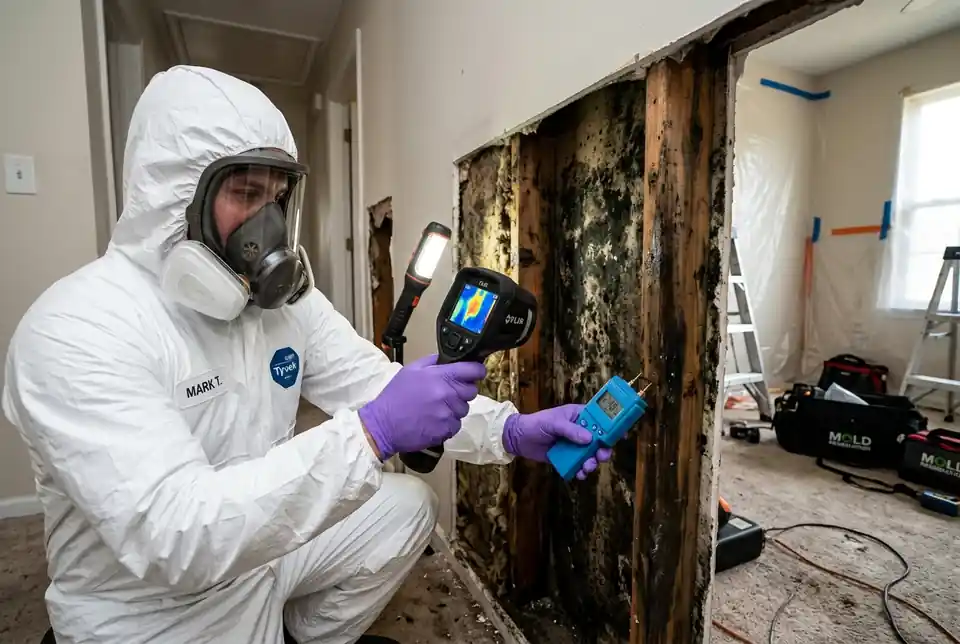
In the coastal South Bay basin of Los Angeles County, indoor water intrusion is an urgent race against the clock. According to guidelines established by the EPA and the IICRC S500 Standard for Professional Water Damage Restoration, airborne microbial spores present in indoor environments require only 24 to 48 hours of elevated moisture (relative humidity above 60%) to begin active cellular germination on organic building materials such as drywall paper, subfloor plywood, and structural Douglas fir framing lumber.
Whether you are dealing with a sudden pressurized copper pipe rupture in a 1920s Spanish Revival bungalow in Morningside Park, an upstairs water heater failure in a Carlton Square townhome, or foundation water intrusion near Fairview Heights, following these five critical, scientifically verified steps will protect your property value and prevent a catastrophic mold remediation loss.
Understanding Inglewood’s 24 to 48-Hour Microbial Window & Coastal Marine Layer
Properties in Inglewood face a distinct environmental vulnerability that inland cities avoid: the persistent Southern California marine layer. Even on warm afternoons when temperatures across the Centinela Valley reach 75°F to 80°F, evening ocean air regularly sweeps inland from Santa Monica Bay and Playa Del Rey, pushing nighttime outdoor relative humidity across Century Boulevard and Manchester Boulevard past 75% to 85%.
When an indoor water loss occurs, this heavy maritime humidity prevents natural evaporative drying. If windows are opened in an attempt to "air out" the building, damp coastal air is drawn directly into affected rooms, accelerating fungal incubation inside closed wall cavities rather than drying them.
"Microbial spores do not wait for an insurance adjuster's schedule. In temperatures between 68°F and 86°F with organic dust and paper-faced gypsum, fungal strains like Aspergillus, Penicillium, and Stachybotrys chartarum begin vegetative hyphae growth within 24 to 48 hours of liquid contact."
To interrupt this biological cycle and achieve verified structural clearance, property owners and certified restoration specialists must execute five sequential technical steps immediately.
Step 1: Rapid Water Source Isolation & High-Volume Extraction in Inglewood Properties
The first imperative in any water incident is shutting down water flow and removing standing liquid. Unbound pooling water exerts continuous hydrostatic pressure, driving moisture deep into concrete slab capillaries, sill plates, and subflooring.
- Locate and shut off main supply valves: In older single-family homes throughout North Inglewood and Inglewood Knolls, the main shutoff is typically a brass gate valve located along the front foundation wall or near the street meter box. In contemporary multi-family developments such as Grace Park or Renaissance, unit-specific shutoffs are usually located in laundry closets or under kitchen sinks.
- Deploy commercial truck-mounted extraction: Standard shop vacs and household towels lack the continuous cubic-feet-per-minute (CFM) lift needed to pull water from subfloors and slab pores. Truck-mounted vacuum units extract hundreds of gallons of water within minutes, removing up to 95% of liquid water before it can wick upward into framing.
- Evacuate subterranean crawlspaces: In raised-foundation homes common to Centinela Heights, standing water pooling in crawlspaces must be pumped out immediately with submersible trash pumps to stop moisture from migrating into floor joists.
For 24/7 commercial-grade pumping and suction, connect with our local water extraction services in Inglewood.
Step 2: Strip Saturated Porous Building Assemblies Across Inglewood Wall & Floor Systems
Certain water-damaged materials cannot be reliably sanitized once soaked. Leaving contaminated porous assemblies in place creates a permanent feeding ground for mold colonies.
- Remove and discard wet carpet padding: While high-grade synthetic carpeting can often be salvaged if treated promptly, bonded urethane foam carpet pad acts like a dense sponge. Retaining soaked carpet underlayment guarantees sour microbial odors and mildew colonization within 48 to 72 hours.
- Execute precision drywall flood cuts: Gypsum wallboard contains cellulose paper facing that serves as primary mold food. Because drywall wicks water upward through capillary action, certified technicians make clean horizontal flood cuts 12 to 24 inches above the highest wet mark, removing soaked fiberglass insulation and exposing wet wall studs to direct airflow.
- Detach baseboards for wall cavity venting: In historic plaster homes across Morningside Park, technicians carefully pry off solid wood baseboards and drill small 5/8-inch weep holes into wall cavities to circulate dry air without demolishing irreplaceable vintage plaster walls.
Step 3: Establish Controlled Psychrometric Drying to Overcome South Bay Coastal Humidity
Mold cannot survive or reproduce in an indoor environment where relative humidity is strictly controlled below 50%. However, simply blowing air with standard household fans only circulates humid coastal air and aerosolizes loose spores throughout the home.
Certified structural drying relies on balanced psychrometric principles:
- Low-Grain Refrigerant (LGR) Dehumidifiers: LGR units continuously draw ambient water vapor out of the atmosphere, reducing grains per pound (GPP) below 35 GPP. This creates a deep vapor pressure differential that actively pulls deeply absorbed moisture out of dense timber, concrete foundations, and subfloor assemblies.
- High-Velocity Axial Air Movers: Commercial air movers are positioned at precise 45-degree angles along perimeter walls to shear away the stagnant moisture boundary layer, transferring moisture from damp building surfaces into the air where dehumidifiers capture it.
- Negative Air & Containment Barriers: When drying localized water leaks in living areas, technicians erect 6-mil polyethylene containment barriers with HEPA air scrubbers to isolate the drying zone and protect unaffected living spaces from particulate drift.
Discover how our certified drying technicians compute daily psychrometric curves on our structural drying services page.
Step 4: Apply EPA-Registered Botanical Biocides to Inglewood Framing & Subfloors
Even after bulk water is extracted, damp lumber, concrete, and subfloor surfaces harbor dormant micro-colonies of bacteria and fungi. Applying hospital-grade antimicrobial solutions neutralizes these microorganisms before assemblies are enclosed.
- Thymol-based botanical formulations: Restorers use EPA-registered biocides formulated with natural thyme-oil thymol. These solutions deliver a 99.99% kill rate against fungal spores, gram-negative bacteria, and viruses while remaining completely non-toxic and hypoallergenic for families and pets in residential neighborhoods like Lockhaven and Hollypark Knolls.
- Ultra-Low Volume (ULV) cold fogging: ULV atomizers dispense fine antimicrobial droplets into tight interstitial cavities—including plumbing chases, floor joist bays, and ceiling voids—ensuring complete surface contact.
- The critical risk of chlorine bleach: Applying household bleach to porous wood framing is ineffective. Bleach consists of roughly 90% water; while chlorine chemicals quickly evaporate on the wood surface, moisture penetrates deep into the grain, feeding dormant fungal roots (hyphae) beneath the surface.
If visible mold staining or musty odors are already present in your home, consult our detailed mold remediation protocol in Inglewood.
Step 5: Conduct Thermal Diagnostics & Moisture Verification Across Inglewood Structures
The single greatest cause of recurring mold problems is assuming a wall is dry simply because its surface feels dry to the touch. Drywall paint and tile surfaces frequently feel completely dry while structural wood framing behind them remains saturated at 28% moisture content.
Verification must be empirical, scientific, and documented:
- FLIR Thermal Infrared Imaging: Infrared cameras detect temperature differentials caused by evaporative cooling, pinpointing hidden water migration behind bathroom tiles, kitchen backsplashes, and insulated ceiling bays without unnecessary demolition.
- Calibrated Pin & Pinless Moisture Meters: Technicians measure the Wood Moisture Equivalent (WME) of studs and subfloors. Dry wood framing in the Inglewood microclimate sits between 10% and 12% WME. Drying equipment must remain active until saturated studs reach safe equilibrium below 16% WME, the biological limit for mold dormancy.
- Daily Insurance Psychrometric Logs: Technicians record temperature, relative humidity, and GPP every 24 hours. These detailed logs provide indisputable scientific proof to insurance adjusters (including State Farm, Farmers, Allstate, and Mercury) that mitigation adhered to professional standards.
Microclimate & Structural Moisture Vulnerabilities Across Inglewood Neighborhoods
Inglewood’s diverse housing stock includes distinct architectural eras that dictate how moisture travels through building envelopes:
- Morningside Park & Fairview Heights: 1920s–1940s Spanish Colonial and Craftsman homes feature dense lath-and-plaster walls and raised crawlspaces. Plaster holds trapped moisture significantly longer than drywall, requiring desiccant dehumidifiers to prevent structural delamination and joist rot.
- Century Heights, Inglewood Knolls & Lockhaven: 1950s single-family ranch homes built on slab foundations. Pressurized subterranean copper line breaks force moisture beneath foundation slabs, requiring specialized floor-drying injection systems to prevent mold growth beneath hardwood and tile.
- Carlton Square, Grace Park & Renaissance: Multi-story gated townhome and condominium communities with shared acoustic party walls and vertical plumbing chases. Multi-level leaks require negative-air containment barriers to prevent cross-contamination between adjoining residences.
- Downtown Inglewood & Imperial Village: Commercial properties and historic brick-and-timber retail buildings along Market Street and Manchester Boulevard, where high ceilings require high-volume desiccant equipment to control large air volumes.
When Inglewood Property Owners Must Engage Certified Restoration Specialists
While wiping up minor surface spills is manageable for homeowners, immediate professional emergency dispatch is legally and medically recommended whenever:
- Standing water has remained unaddressed for longer than 24 hours.
- Water originates from a Category 3 biohazard source (sewage backflow, toilet overflow containing waste, or storm street runoff).
- Water has migrated behind tiled shower enclosures, under built-in kitchen cabinetry, or beneath glued hardwood flooring.
- Persistent damp, earthy, or mushroom-like odors are noticeable upon entering the room.
For immediate 24/7 emergency dispatch across all Inglewood zip codes (90301, 90302, 90303, 90304, 90305), connect with Inglewood Water Damage Pros directly.
Need Immediate Moisture Extraction & Mold Prevention in Inglewood?
Do not allow trapped water to develop into an expensive microbial hazard. Our certified emergency restoration crews arrive on-site within 20 to 45 minutes equipped with truck-mounted vacuum extractors, commercial LGR dehumidifiers, and calibrated thermal imaging sensors.
Call our 24/7 Inglewood dispatch hotline now at (424) 550-5779 for immediate on-site moisture evaluation and mold prevention.