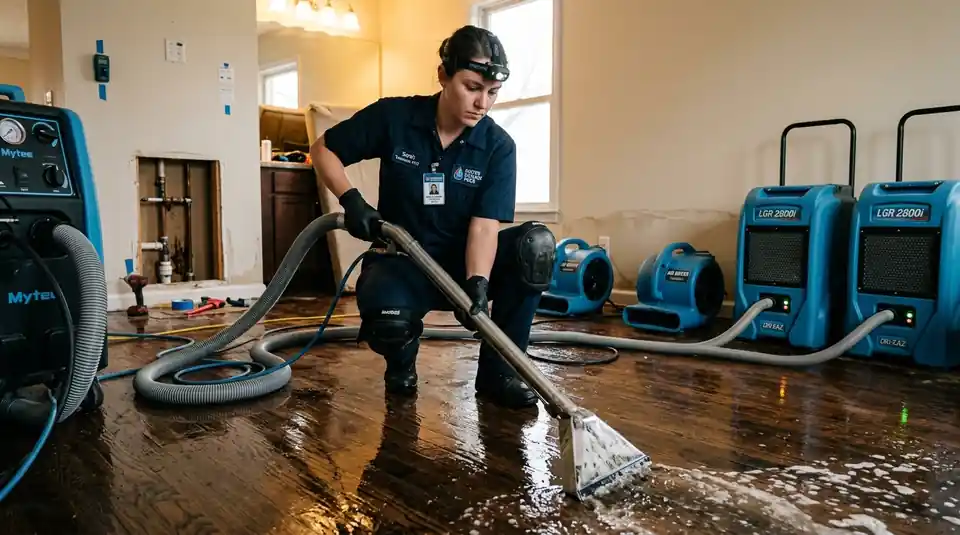
Under IICRC S500 Standards for Professional Water Damage Restoration, clean Category 1 water escaping from a fresh supply pipe degrades into Category 2 ("gray water") within 24 to 48 hours once it dissolves organic compounds in drywall paper and subflooring adhesives. Rapid mechanical extraction and targeted cavity dehumidification must occur before microbial amplification commences. Follow our 5 critical steps to prevent mold growth immediately after isolating the leak.
Inglewood Plumbing Vulnerabilities: Age, Soils, and Water Pressure
Inglewood features diverse architectural periods, ranging from Spanish Colonial Revival residences built in the 1920s to post-war mid-century tract homes and modern master-planned communities. These differing construction eras introduce specific plumbing stress factors:
1. Aged Galvanized Steel in Morningside Park & Fairview Heights
Properties constructed between 1925 and 1955 throughout Morningside Park, Fairview Heights, and Centinela Heights frequently feature original galvanized iron supply lines. Over six to eight decades, internal chemical reactions between minerals and zinc coatings cause tuberculation—a calcified internal narrowing of the pipe. As interior friction climbs and pipe walls oxidize to paper-thin tolerances, small pressure variations cause longitudinal seam splits inside interior wall cavities.
2. Copper Pinhole Pitting in Century Heights & Lockhaven
Mid-century homes across Century Heights and Lockhaven predominantly utilize copper water piping. While durable, copper lines installed between the 1960s and 1980s are vulnerable to electrochemical pitting corrosion. Aggressive municipal water flow dynamics, aggressive soil chemistry in uninsulated ground sleeves, and residual soldering flux cause localized pit corrosion that bursts unexpectedly beneath tiled shower surrounds or behind kitchen cabinets.
3. Expansive Clay Soils & Ground Movement
Much of the South Bay and Centinela Valley sits atop expansive clay loam that expands during seasonal winter Pacific storms and contracts during dry Southern California summers. This cyclical sub-soil shifting imposes intense shear forces on rigid plumbing lines passing through exterior footings and unreinforced concrete foundation slabs.
Non-Invasive Diagnostic Technology: Locating Leaks Without Sledgehammers
In previous decades, discovering a hidden pipe leak meant blindly demolishing walls and jackhammering floors until plumbers spotted pooling water. Today, certified restoration technicians employ scientific, non-destructive diagnostic suites to pinpoint hidden failures within fractions of an inch:
| Diagnostic Tool | Operational Principle | Best Inglewood Application |
|---|---|---|
| FLIR High-Resolution Thermal Imaging | Detects micro-temperature variations caused by evaporative cooling or hot water supply line radiant heat. | Scanning multi-story ceiling assemblies and insulated partition walls in Carlton Square and Renaissance townhomes. |
| Acoustic Listening & Ground Microphones | Amplifies high-frequency hiss (500 Hz to 2 kHz) produced by pressurized fluid escaping through pipe fissures. | Locating slab leaks beneath tile, hardwood, and concrete in Morningside Park and Inglewood Knolls homes. |
| Dual-Mode Tramex Moisture Meters | Measures electrical impedance (non-invasive) and electrical resistance (penetrating pins) to map depth of saturation. | Establishing definitive structural drying boundaries behind custom baseboards and under engineered flooring. |
| Gas Tracer Technology (Helium/Hydrogen) | Injects safe non-flammable tracer gas into isolated plumbing lines that escapes through microscopic fractures for sniffing sensors. | Detecting hairline micro-leaks under outdoor driveways or foundational footings where ambient acoustics are compromised. |
By triangulating thermal patterns with acoustic amplification, technicians can mark the precise 4-inch zone where the pipe breached. This eliminates unnecessary demolition, preserving intact cabinetry and architectural plasterwork.
5-Step Mitigation Protocol for Inglewood Burst Pipe Incidents
When a plumbing failure strikes, following a strict IICRC-compliant engineering protocol limits financial loss and prevents hazardous fungal contamination:
- Emergency Water Supply Interruption: Immediately locate your property’s primary water shutoff valve. In single-family Inglewood bungalows, this is typically a brass ball valve located at the front exterior hose bib riser or inside the parkway meter box near the curb. Turn the lever 90 degrees perpendicular to the pipe (or turn round gate valves clockwise until completely snug).
- De-energize Compromised Electrical Circuits: If water has entered ceiling drywall, track lighting, or lower wall outlets, shut off circuit breakers servicing those rooms at the main electrical panel to eliminate electrocution hazards and arc-fault ignition.
- Non-Invasive Diagnostic Moisture Mapping: Before opening walls, certified technicians sweep all adjacent structures using calibrated thermal cameras and dielectric moisture meters. This maps the full hydraulic footprint behind lath, plaster, and fiberglass insulation.
- Precision Inspection Cuts & Cavity Aeration: Rather than tearing down entire walls, technicians make surgical 4-to-6-inch flood cuts or insert precision injection ports beneath baseboards. High-pressure air injection systems (such as Injectidry) circulate heated dry air directly into wet stud cavities.
- Industrial Psychrometric Dehumidification: Commercial Low-Grain Refrigerant (LGR) dehumidifiers and high-velocity axial fans are positioned to maintain ambient relative humidity below 45% and drive structural wood framing below 16% Wood Moisture Equivalent (WME).
Slab Leaks vs. Raised Foundation Crawlspace Ruptures
Restoration procedures differ substantially depending on your home’s architectural foundation type:
Concrete Slab Foundations (Common in Post-1960 Inglewood Homes)
In slab-on-grade construction, copper supply lines are encased directly beneath or within 4-to-6-inch concrete foundations. When a leak occurs:
- Signs: Unexplained warm patches on tile or laminate flooring, sound of water hissing while fixtures are dormant, moisture wicking upward into bottom drywall baseboards.
- Risk: Water erodes supporting subterranean soil, causing foundational settlement, floor cracking, and expensive slab heave.
- Restoration: Electronic acoustic pinpointing allows localized single-tile breakout or directs professional re-routing of overhead PEX piping through the attic space.
Raised Foundations with Subfloor Crawlspaces (Historic 1920s–1940s Homes)
In vintage Spanish and Craftsman bungalows across Fairview Heights and Morningside Park, plumbing lines run through open crawlspaces beneath tongue-and-groove hardwood subflooring.
- Signs: Spongy or cupping hardwood planks, musty earthen smells rising through floor vents, localized mold growth along baseboard perimeters.
- Risk: Damp crawlspace air trapped by poor perimeter foundation venting creates an ideal incubator for subterranean fungal rot and structural timber decay.
- Restoration: Heavy-duty crawlspace extraction, sub-floor drying mats, and antimicrobial treatment applied directly to saturated floor joists.
Navigating Insurance Claims: The Value of Moisture Documentation Logs
California property insurance carriers require comprehensive empirical verification before paying out water restoration and structural rebuild claims. Incomplete or amateur documentation often results in claims denials under the "gradual leak / ongoing neglect" exclusion clause.
Professional restoration specialists safeguard your claim by maintaining daily psychrometric dry logs:
Consult our comprehensive breakdown of water damage restoration costs in Inglewood to understand local pricing tiers and deductible handling.
- Initial Moisture Readings: Documented percentage of saturation in drywall, sill plates, and subfloors immediately upon arrival.
- Infrared Thermal Mapping Photos: High-definition radiometric images capturing temperature variances and establishing the precise perimeter of water migration.
- Equipment Deployment Calculations: Sizing formulas proving that the exact volume of LGR dehumidifiers and air movers met IICRC S500 standard requirements.
- Daily Drying Progress Curves: Certified psychrometric data demonstrating that structural materials were systematically brought back to established dry standard baselines.
Stop Hidden Water Damage in Inglewood Today
Unattended pipe bursts cause irreparable structural damage and mold infestation within 24 hours. Our dispatch team is equipped with advanced FLIR thermal imaging and high-volume extraction equipment to restore your property immediately.