Scientific Structural Drying Protocols in Inglewood, CA: IICRC S500 Moisture Remediation
When flooding strikes an Inglewood property, removing standing water is only 10% of the battle. Learn how certified psychrometric drying, GPP reduction, and LGR dehumidification save framing from rot.
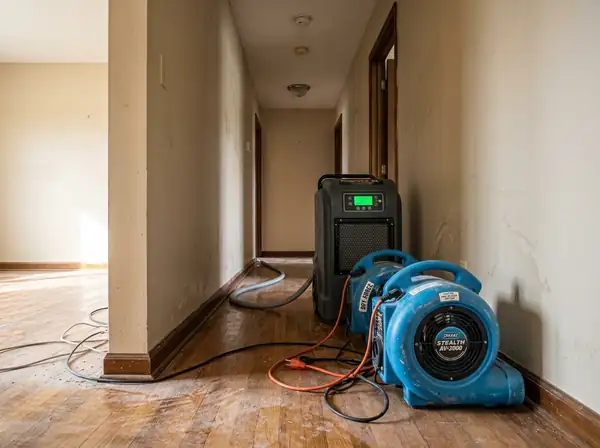
When unexpected pipe breaks, fixture failures, or storm runoffs flood a building in Inglewood, CA, clearing standing surface water is only the first ten percent of the challenge. The true danger lies in bound moisture absorbed into subfloors, wall framing studs, drywall gypsum cores, and concrete foundation slabs. Without rigorous, engineered structural drying protocols, trapped dampness triggers microbial decay and wood rot within 48 to 72 hours.
Proper drying is an exact thermodynamic science governed by the IICRC S500 Standard and Reference Guide for Professional Water Damage Restoration. Technicians do not guess whether building assemblies are dry by touching wall surfaces; they calculate vapor pressure gradients, grain depression, and wood moisture equilibrium across every square foot of affected real estate.
The Thermodynamic Engine: How Psychrometrics Drives Structural Remediation
Structural drying relies on psychrometry—the scientific study of atmospheric air and water vapor interactions. Moisture inside saturated framing always attempts to reach equilibrium with surrounding room air. When our specialists service homes throughout Morningside Park, Century Heights, and Fairview Heights, we manipulate three interconnected environmental variables:
- Specific Humidity / Grains Per Pound (GPP): The absolute weight of water vapor in dry air. Drying only accelerates when the dehumidifier output exhaust exhibits substantial grain depression (ideally 30+ GPP below ambient room air).
- Vapor Pressure Differential: Water molecules always migrate from areas of high vapor pressure (wet building materials) toward lower vapor pressure (bone-dry conditioned air). Maximizing this differential extracts moisture deep out of structural timber.
- Laminar Boundary Layer Disruption: Saturated surfaces develop a thin micro-layer of cool, stagnant, humid air immediately above them. High-velocity air movers strip away this boundary layer so fresh, dry air can continuously absorb trapped water.
Why Box Fans & Open Windows Often Fail in Coastal Southern California: Inglewood properties frequently catch humid maritime airflow rolling eastward from Santa Monica Bay and LAX. Opening exterior windows often introduces air with relative humidity exceeding 75% and 80+ GPP, stalling interior evaporation and feeding latent spore growth. Certified structural drying requires closed-chamber mechanical drying systems.
The 5-Phase Scientific Structural Drying Protocol
Below is the systematic engineering protocol deployed during our professional structural drying services across commercial and residential structures in Inglewood, CA.
-
Phase 1: Psychrometric Baselines & Deep Moisture Mapping (0 - 4 Hours)
Drying cannot begin without defining what constitutes "dry" for the specific structure. Technicians identify an unaffected control room built from identical materials to establish the Dry Standard (typically 8% to 12% Wood Moisture Equivalent in Southern California). Using thermal imaging cameras (FLIR infrared sensors), technicians map the subterranean boundary of hidden water plumes behind baseboards, beneath floating vinyl planks, and inside wall cavities without destructive tear-outs.
-
Phase 2: Aggressive Physical Water Removal (4 - 8 Hours)
Liquid extraction is 500 times faster and vastly more energy-efficient than mechanical evaporation. Before turning on any dehumidifiers, our technicians deploy high-vacuum extraction systems as outlined in our guide on truck-mounted water extraction to lift standing water from carpeting, underlayment padding, and subfloor assemblies. For saturated hardwood floors in historic homes around Centinela Heights, we connect pressurized vacuum mat systems (Rescue Mats).
-
Phase 3: Precision Airflow Geometry & Cavity Injection (8 - 12 Hours)
Airflow must be directed at precise angles to penetrate boundary layers without aerosolizing dust or microbial contaminants. IICRC S500 formulas dictate the exact quantity of axial and centrifugal air movers based on square footage, ceiling height, and surface permeance ratings. When water has wicked into wall cavities—common after sudden pipe ruptures documented in our emergency burst pipe cleanup protocol—specialized injector tubes are inserted into small holes drilled behind baseboards to flush wall cavities with high-pressure warm, dry air.
-
Phase 4: Low-Grain Refrigerant (LGR) Dehumidification (24 - 96 Hours)
As axial fans evaporate gallons of bound moisture out of framing, the room's relative humidity skyrockets. We install industrial Low-Grain Refrigerant (LGR) dehumidifiers. Unlike standard consumer units that shut off once air reaches 50% relative humidity, LGR systems pre-cool incoming air, allowing them to extract moisture down to 30% RH and below 35 GPP. This ultra-low humidity creates an insatiable thermodynamic vacuum that pulls deeply embedded moisture out of thick wall studs and concrete foundations.
-
Phase 5: Daily Psychrometric Logs & Structural Clearance (Days 3 to 5)
A certified IICRC technician visits the property every 24 hours to record moisture readings at identical test coordinates. Equipment is adjusted, relocated, or powered down based on progress metrics. Equipment is never demobilized until building materials reach the predetermined dry standard—verified with insulated deep-wall pin probes showing wood framing under 16% Wood Moisture Equivalent (WME) and concrete subfloors within safe RH tolerance.
Comparison: Class 1 Through Class 4 Water Intrusion Sizing
The IICRC S500 categorizes structural water damage into four distinct classes based on the rate of evaporation required. Understanding your building's classification determines equipment density:
| IICRC Class | Affected Assemblies | Evaporation Rate | Drying Technology Required |
|---|---|---|---|
| Class 1 | Small area; only low-porosity materials like plywood or concrete affected (<5% of room surfaces). | Slowest rate of evaporation. | Targeted axial air movers + compact commercial LGR dehumidifier. |
| Class 2 | Entire room flooded; carpet and cushion saturated; moisture wicked up drywall less than 24 inches. | Fast evaporation rate. | High-capacity LGR units, perimeter vortex air circulation, subfloor extraction. |
| Class 3 | Overhead intrusion; ceilings, insulation, multi-layer drywall, subfloors saturated across multiple rooms. | Fastest evaporation rate. | Industrial desiccant dehumidifiers, ceiling drop arrays, cavity ventilation injectors. |
| Class 4 | Deeply bound water trapped in low-permeance assemblies: hardwood gym floors, plaster walls, brick, crawlspace subsoil. | Very deep, bound water. | Negative pressure vacuum mats, heated desiccant air streams, targeted heat drying. |
Why Inglewood Properties Need Tailored Drying Strategies
Inglewood features a diverse architectural landscape, ranging from Spanish Colonial revival homes in Carlton Square and mid-century residences in Lockhaven to sprawling modern mixed-use complexes around SoFi Stadium and Hollywood Park. Each structural type presents unique drying hurdles:
- Plaster & Lath Construction: Older Inglewood homes built before 1960 often feature thick plaster rather than modern drywall. Plaster holds ten times more bound water than drywall and requires heated drying chambers or extended low-grain dehumidification to prevent delamination.
- Slab-on-Grade Moisture Traps: Concrete slabs common in Southern California act like sponges. If moisture is trapped beneath glued-down luxury vinyl tile (LVT) or commercial carpet, it creates an alkaline vapor emissions scenario that destroys replacement flooring if not properly dried.
- Crawlspace Humidity Reservoirs: Properties in low-lying sections of Hollypark Knolls often accumulate standing dampness in subterranean crawlspaces, requiring industrial negative-air scrubbing and continuous desiccant extraction.
Schedule Structural Drying in Inglewood, CA
When water intrudes, prompt scientific extraction and psychrometric dehumidification protect structural framing from permanent rot and halt toxic mold colonization.
Call (424) 550-5779 for emergency mobile response and certified on-site moisture assessment across all Inglewood neighborhoods.