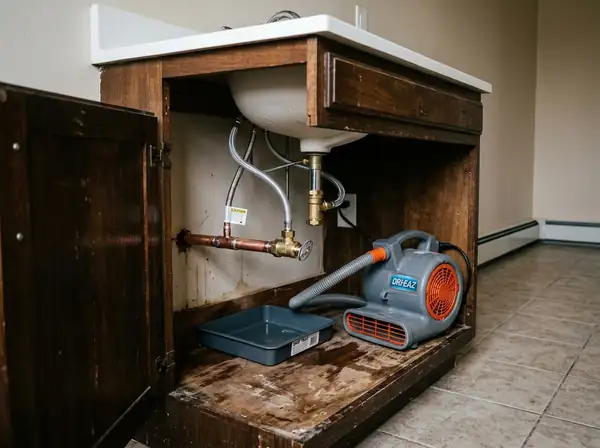
Plumbing supply line ruptures are among the most catastrophic property emergencies in Southern California. Unlike slow cosmetic leaks, a high-pressure pipe breach saturates structural timber, floods concrete slab foundations, and fills interior drywall cavities within minutes.
In historic and established neighborhoods across Inglewood—including Morningside Park, Fairview Heights, and Inglewood Knolls—aging plumbing infrastructure combined with expansive clay soils makes supply line ruptures a frequent hazard. Navigating this emergency requires an exact, multi-stage remediation protocol.
Step 1: Rapid Water Isolation and Pressure Bleed-Down
Every second an active supply pipe bursts, hundreds of gallons enter your structural framing. First-response technicians immediately isolate the primary water meter or main brass quarter-turn ball valve at the exterior front riser.
Once the main valve is shut off, technicians open lowest-level exterior hose bibs to bleed remaining pressurized water out of the plumbing system rather than allowing residual water to siphon through the indoor breach. Review our minute-by-minute first 60 minutes indoor flooding checklist for emergency homeowner procedures.
Step 2: Deep Extraction of Free-Standing Water
Portable shop vacuums cannot generate the suction depth required to remove water from carpet padding, concrete slab micro-pores, or hardwood tongue-and-groove joints. Certified teams mobilize heavy-duty water extraction services using commercial truck-mounted vacuum extractors.
Weighted rover extraction units compress wet carpeting and underlayment, drawing out up to 95% of trapped liquid before it can dissolve carpet adhesives or induce subfloor delamination. Learn more in our detailed guide on truck-mounted water extraction benefits in Inglewood.
Step 3: Thermal Infrared Diagnostic Mapping & Precision Flood Cuts
Water escaping an in-wall pipe burst runs horizontally along floor sill plates, migrating across multiple rooms behind closed walls. Using FLIR thermal imaging cameras and dielectric moisture meters, technicians map the exact boundary of hydraulic intrusion without destructive demolition. For hidden leak indicators, explore our guide on detecting hidden pipe leaks in older Inglewood homes.
Where moisture exceeds baseline thresholds (greater than 16% Wood Moisture Equivalent), technicians perform controlled 4-to-12 inch inspection flood cuts behind baseboards. This relieves trapped moisture inside wall cavities, preventing mold amplification inside fiberglass insulation and lath.
Step 4: Specialized In-Wall Cavity Drying & LGR Dehumidification
Standard room fans only blow ambient air across outer sheetrock surfaces, leaving inner timber studs saturated. Professional restoration crews deploy positive-pressure cavity drying systems (such as Injectidry) that pump heated, moisture-free air directly into wall bays through small injection ports.
Concurrently, Low-Grain Refrigerant (LGR) dehumidifiers are positioned to capture evaporated water vapor from the room air, keeping relative humidity (RH) strictly below 45% to arrest microbial growth. Read our detailed 5 critical steps to prevent mold after water intrusion to understand the science behind 24-48 hour containment.
Step 5: Daily Moisture Logs and Direct Insurance Billing
California property insurance adjusters require empirical evidence that structural drying met standard IICRC S500 guidelines before approving reimbursement. Technicians record daily temperature, relative humidity, and dew point measurements to establish psychrometric drying curves.
Once framing lumber returns to baseline equilibrium (under 16% WME), drying equipment is demobilized and complete interior reconstruction commences. To plan for deductibles and scope estimates, review our Inglewood water damage restoration cost breakdown.
Why DIY Cleanup Fails After an Inglewood Burst Pipe Incident
Homeowners who rely on towels, household fans, or rental shop vacuums inevitably face secondary disasters weeks later:
- Hidden Sill Plate Rot: Water pooling on foundation sill plates beneath drywall creates structural timber decay that is invisible until floors sag.
- Sub-Slab Cavitation: Foundation slab leaks in neighborhoods like Century Heights and Lockhaven wash out supporting subterranean soil, causing expensive slab settling.
- Hazardous Fungal Colonization: Wet drywall paper provides an ideal cellulose breeding ground for Stachybotrys chartarum (toxic black mold) when relative humidity remains elevated.
- Insurance Claim Complications: Adjusters may reduce or dispute coverage if independent documentation is missing or if drying was handled without certified psychrometric equipment.
Need 24/7 Emergency Burst Pipe Cleanup in Inglewood CA?
Do not let escaping water compromise your home's foundation or framing. Our local dispatch team arrives on-site within 20 to 45 minutes equipped with truck-mounted vacuum units, thermal imaging cameras, and commercial cavity drying systems.
Call our 24/7 emergency hotline at (424) 550-5779 to mobilize immediate burst pipe mitigation and structural extraction.